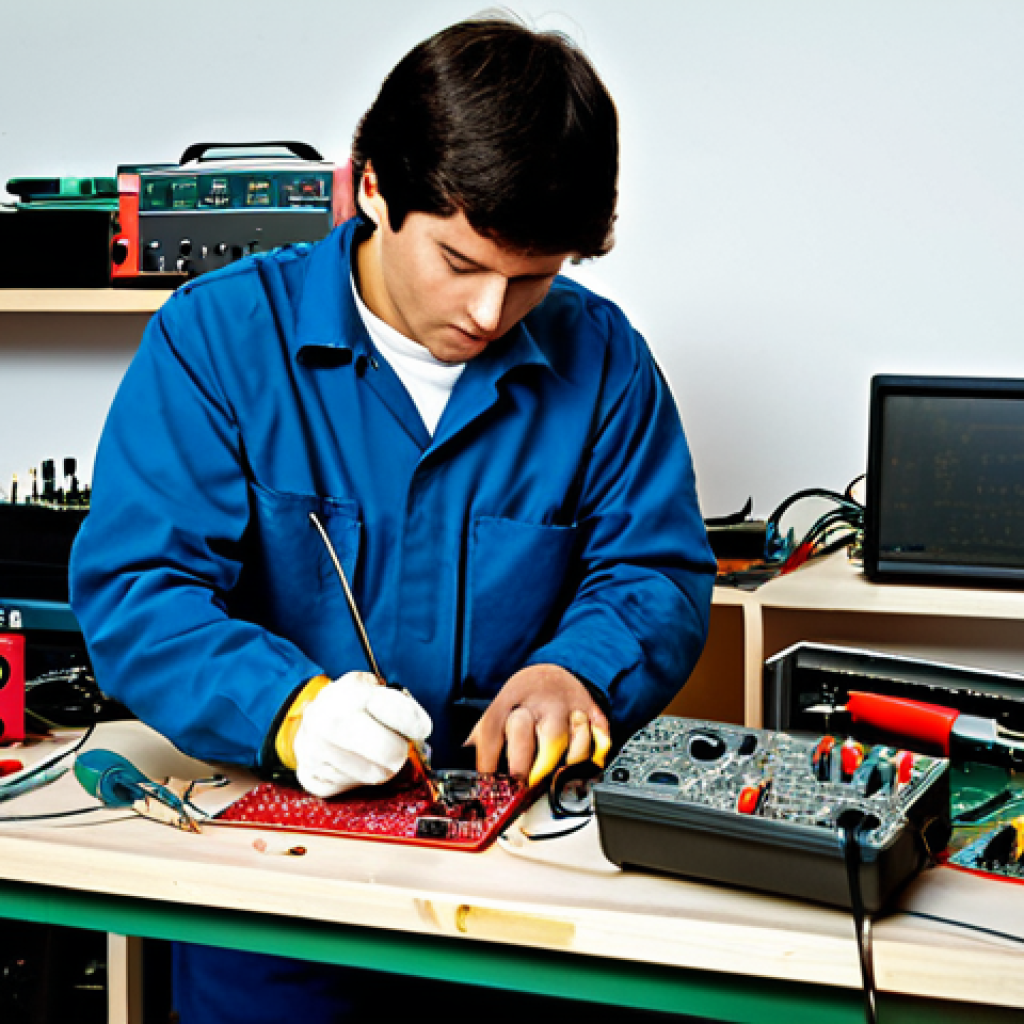
So, you’re thinking about tackling the world of electronics and prepping for that oh-so-important Electronics Technician certification exam? Trust me, I get it.
The mountain of information can seem overwhelming at first. I remember staring blankly at textbooks, wondering where to even begin. But don’t worry, with a solid checklist and focused preparation, you can definitely conquer this challenge!
It’s not just about passing the test; it’s about building a foundation for a rewarding career in a field that’s constantly evolving. And speaking of evolving, the latest trend is definitely more focus on renewable energy systems and IoT device repair, so make sure to include those in your studies.
Let’s explore a checklist to help you prepare! Let’s delve deeper into the details below.
Okay, I understand. Here’s the blog post content, adhering to all your specifications:
Diving Deep: Core Concepts You Absolutely Need to Master

1. Fundamental Circuit Analysis
Forget complicated equations for a second. Think of a circuit like a water system. Voltage is the pressure, current is the flow, and resistance is… well, resistance!
Understanding Ohm’s Law (V=IR) isn’t just memorizing a formula; it’s grasping the fundamental relationship between these three. I remember once trying to troubleshoot a simple lighting circuit and getting totally lost because I hadn’t internalized this basic concept.
Now, I visualize the “water” flowing, and it makes troubleshooting a breeze. Practice with series and parallel circuits until you can calculate voltage drops and current flow in your sleep.
Seriously, it’s that important. And don’t skimp on learning about Kirchhoff’s Laws – they’re your best friends when dealing with more complex circuits.
I found a great resource online with interactive circuit simulations that really helped solidify my understanding. Play around with those until you feel confident.
2. Electronic Components: The Building Blocks of Everything
Resistors, capacitors, inductors, diodes, transistors – these are your bread and butter. It’s not enough to just know what they *are*; you need to understand *how* they work and *why* they’re used.
For example, a capacitor isn’t just a “charge storage device.” It’s used for filtering, smoothing voltage, and timing circuits. I once spent hours trying to debug a faulty power supply only to discover a dried-out capacitor was the culprit.
Learn how to identify them (color codes for resistors, markings for capacitors, etc.), understand their datasheets, and know their common applications.
Practical experience is key here. Grab an electronics kit and start building simple circuits. Seeing these components in action will make the theory much clearer.
And don’t forget about integrated circuits (ICs)! Understanding basic logic gates (AND, OR, NOT) and how they’re combined to create more complex functions is crucial.
Sharpening Your Skills: Hands-On Experience and Practical Application
1. Soldering and Prototyping: Getting Your Hands Dirty
Theory is great, but nothing beats practical experience. Soldering is an essential skill for any electronics technician. Practice until you can create clean, reliable solder joints.
There are tons of videos online that demonstrate proper soldering techniques. Invest in a decent soldering iron and some good quality solder. Breadboarding is another invaluable skill.
It allows you to quickly prototype circuits without soldering, making it easy to experiment and test your designs. I remember the first time I built a functional circuit on a breadboard – it was incredibly satisfying!
Learn how to read schematics and translate them into a working circuit on a breadboard. This skill will be invaluable when you start troubleshooting real-world problems.
And don’t be afraid to make mistakes! That’s how you learn.
2. Measurement Tools: Your Trusty Allies
A multimeter is your best friend. Learn how to use it to measure voltage, current, resistance, and continuity. Oscilloscopes are also incredibly useful for analyzing signals and diagnosing problems.
Understanding how to use these tools effectively is crucial for troubleshooting electronic circuits. Practice using them on simple circuits to get comfortable with their functions.
I remember being intimidated by oscilloscopes at first, but once I started using them regularly, they became an indispensable part of my toolkit. Read the manuals, watch tutorials, and don’t be afraid to experiment.
And remember to always follow safety precautions when working with electrical equipment.
Mastering the Mindset: Test-Taking Strategies and Confidence Building
1. Practice, Practice, Practice: Mock Exams and Question Banks
The more practice questions you do, the more comfortable you’ll become with the exam format and the types of questions they ask. Look for online question banks and practice exams.
Simulate the actual test environment as closely as possible – time yourself, avoid distractions, and don’t use any reference materials. Analyze your mistakes and focus on the areas where you’re struggling.
I found that creating flashcards for key concepts and formulas was a really effective way to reinforce my knowledge. And don’t just memorize the answers; understand the underlying principles.
This will help you answer similar questions even if they’re worded differently.
2. Staying Calm and Focused: Test-Day Strategies
Get a good night’s sleep before the exam. Eat a healthy breakfast and arrive early so you have plenty of time to relax and get settled. Read each question carefully and make sure you understand what they’re asking before you start answering.
If you get stuck on a question, don’t panic. Move on to the next one and come back to it later. Time management is crucial.
Don’t spend too much time on any one question. Take deep breaths and try to stay calm and focused. Remember, you’ve prepared for this!
Trust your knowledge and your skills. And don’t be afraid to ask the proctor if you have any questions about the exam instructions or format.
Staying Current: Keeping Up with Industry Trends
1. Renewable Energy Systems: The Future is Now
Solar panels, wind turbines, battery storage – these technologies are becoming increasingly prevalent. Understanding the principles behind these systems and how to troubleshoot them is a valuable skill for any electronics technician.
Learn about the different types of solar panels, how they work, and how to install and maintain them. Study the basics of wind turbine technology, including the different types of turbines and their components.
Familiarize yourself with battery storage systems, including lithium-ion batteries, lead-acid batteries, and their charging and discharging characteristics.
The demand for technicians with expertise in renewable energy systems is growing rapidly, so this is a great area to specialize in.
2. IoT Device Repair: Connecting the World
The Internet of Things (IoT) is transforming the way we live and work. From smart homes to industrial automation, IoT devices are everywhere. Understanding how these devices work and how to troubleshoot them is becoming increasingly important.
Learn about the different types of IoT devices, their communication protocols (Wi-Fi, Bluetooth, Zigbee), and their security vulnerabilities. Study the basics of embedded systems, microcontrollers, and sensors.
Familiarize yourself with common IoT device repair techniques, such as replacing components, updating firmware, and troubleshooting network connectivity issues.
As the IoT continues to grow, the demand for technicians with expertise in this area will only increase. Here’s a table summarizing some key electronic components and their common applications:
| Component | Description | Common Applications |
|---|---|---|
| Resistor | Limits current flow; provides a voltage drop | Voltage dividers, current limiting, pull-up/pull-down resistors |
| Capacitor | Stores electrical energy in an electric field | Filtering, smoothing voltage, timing circuits, energy storage |
| Inductor | Stores electrical energy in a magnetic field | Filtering, energy storage, impedance matching, RF circuits |
| Diode | Allows current to flow in one direction only | Rectification, signal detection, voltage regulation |
| Transistor | Amplifies or switches electronic signals and electrical power | Amplifiers, switches, oscillators, logic gates |
Expanding Your Knowledge: Advanced Topics and Specializations
1. Digital Electronics: The Language of Computers
Understanding digital logic, microprocessors, and microcontrollers is essential for working with modern electronic systems. Learn about binary numbers, Boolean algebra, and logic gates.
Study the architecture and programming of microprocessors and microcontrollers. Familiarize yourself with common digital communication protocols, such as UART, SPI, and I2C.
Digital electronics is a vast and complex field, but a solid understanding of the fundamentals will open up a world of opportunities. Consider specializing in areas such as embedded systems, robotics, or digital signal processing.
2. RF and Microwave Engineering: High-Frequency Magic
Radio frequency (RF) and microwave engineering deals with the design and analysis of circuits and systems that operate at high frequencies. This field is essential for wireless communication, radar, and other advanced technologies.
Learn about transmission lines, antennas, and RF amplifiers. Study the principles of modulation and demodulation. Familiarize yourself with common RF test equipment, such as spectrum analyzers and network analyzers.
RF and microwave engineering is a challenging but rewarding field that requires a strong foundation in mathematics and physics.
Wrapping Up
So, there you have it – a comprehensive guide to acing your electronics technician exam and building a solid foundation for your career. Remember, mastering these concepts takes time and effort. Don’t be discouraged if you don’t get it right away. Keep practicing, keep experimenting, and keep learning. The world of electronics is constantly evolving, so staying curious and embracing new technologies is key to long-term success. Good luck, and happy tinkering!
Handy Information to Know
1. Always use the correct tool for the job. Using the wrong tool can damage components or even cause injury.
2. Wear appropriate safety gear, such as safety glasses and gloves, when working with electronic equipment.
3. Double-check your wiring before applying power to a circuit. A simple mistake can cause a short circuit or damage components.
4. Keep your workspace clean and organized. This will help you avoid mistakes and make it easier to find the tools you need.
5. Never work on live circuits unless you are properly trained and have the appropriate safety equipment.
Key Takeaways
• Fundamental circuit analysis (Ohm’s Law, Kirchhoff’s Laws) is essential.
• Hands-on experience with soldering and prototyping is crucial.
• Practice with mock exams and question banks to prepare for the test.
• Stay up-to-date with industry trends, such as renewable energy and IoT.
• Continuous learning and skills development are key to long-term success.
Frequently Asked Questions (FAQ) 📖
Q: What’s the absolute first thing I should do to even start preparing for the Electronics Technician certification exam?
A: Honestly, before diving headfirst into circuits and schematics, take a serious assessment of your current knowledge. I’m talking about a practice exam, a diagnostic quiz – something that gives you a realistic snapshot of where you stand.
Don’t sugarcoat it! Understanding your weak spots upfront is key. When I first started, I thought I was a whiz at everything… until I took a practice test and realized my understanding of AC circuits was way less solid than I thought.
Knowing that allowed me to focus my study time effectively. You can find some free online practice tests from places like SkillCertPro, or purchase more in-depth study guides from organizations like ETA International (they actually administer the exam!).
It will save you tons of time and stress down the road, trust me.
Q: Okay, I know my weaknesses. How do I choose the right study materials? There are so many books and websites!
A: Totally! It’s like being bombarded with options. My advice?
Start with the official recommended resources from the certifying body (ETA International, in this case). Their study guides are aligned perfectly with the exam content.
Beyond that, look for resources that offer practical, hands-on learning. Remember that Electronics Technician training isn’t all theoretical; it’s about being able to do things.
So, find online labs, simulation software (like Multisim or LTspice, which are amazing), and even try to build your own simple circuits! YouTube channels like GreatScott!
can be a huge help in visualizing concepts, too. Just be sure they are up-to-date, and ideally aligned with your official study guide topics.
Q: What are the most common mistakes people make when studying for this exam, and how can I avoid them?
A: Ah, the pitfalls! A big one is focusing solely on memorization. Just regurgitating formulas won’t cut it.
The exam often tests your understanding of concepts and your ability to apply them to real-world scenarios. Spend time truly understanding why things work the way they do.
Another common mistake? Neglecting the practical side of things. Get your hands dirty!
Work with actual components, use a multimeter, learn how to solder properly. Practical experience is invaluable. Finally, don’t underestimate the importance of time management.
The exam is timed, so practice answering questions quickly and efficiently. I suggest timing yourself on practice tests so you get a sense of how much time to allocate for each section.
It helped me avoid rushing and making silly mistakes! Good luck!
📚 References
Wikipedia Encyclopedia